
No. 01
Antique & Estate Furniture
in Pompano Beach
Mahogany, walnut, and period case pieces.
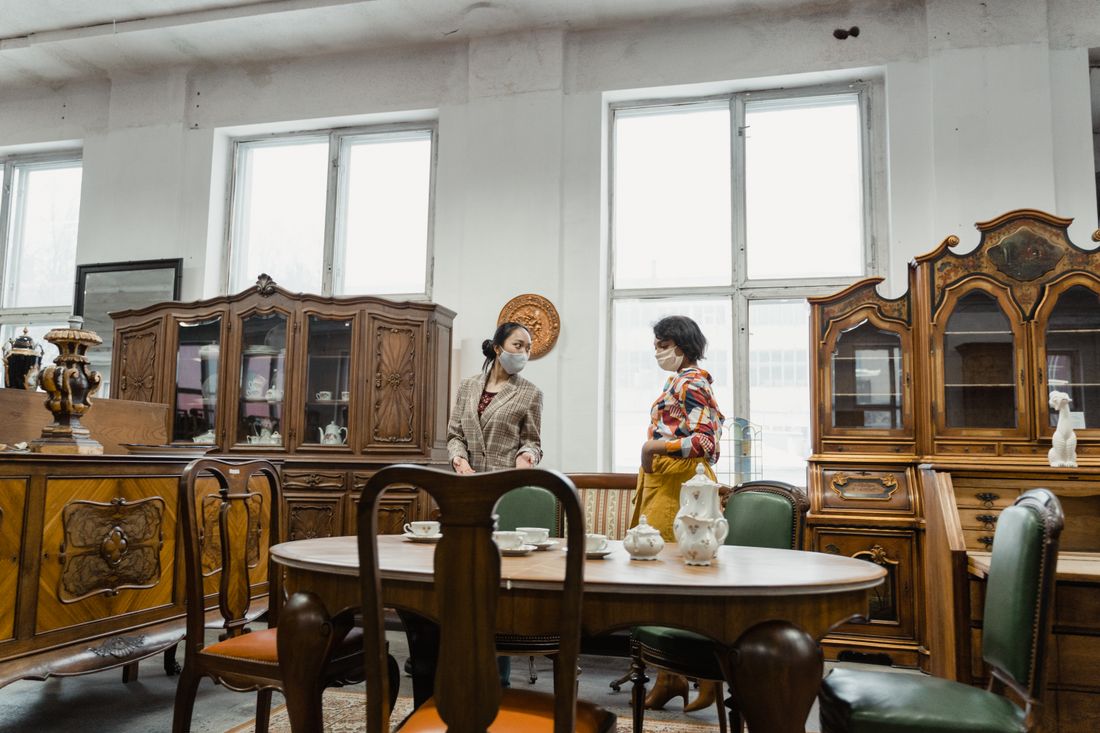
Antique and estate furniture is dated by what the maker's tools, nails, screws and finish left behind, not by a label. At Atlantic Premier Estate Buy in Pompano Beach we read saw marks, dovetails, fasteners and shellac before we quote a price, and we check the wood itself when a claim like "rosewood" or "mahogany" is carrying the value. Send photos of drawer corners, the back boards and any hardware, and we will tell you what the piece really is.
What we look for
- Georgian, Victorian, and Mid-Century Modern pieces
- Signed or labeled cabinetmakers
- Dressers, secretaries, highboys, dining suites
- Original finish and hardware (we do not mind honest wear)
Reading the tool marks: saws, planes and dovetails
Furniture keeps a record of how it was cut. Saw marks on backboards and drawer bottoms come first. Up-and-down saws leave straight, parallel vertical striations, while pit-saw marks run at a slant and vary stroke to stroke. One country-furniture dating series puts the pit saw in America before 1680 and the up-and-down saw from the 1680s until early in the 1900s, so straight marks alone date very little. Curved, arc-shaped kerf marks point to a circular saw, but dealer guides disagree on timing: the same series has the circular saw arriving in the mid-1850s yet too weak for furniture-sized boards until about 1880. Treat arcs as a late-board flag, not a date.
Plane marks work the same way. A hand-planed surface shows faint facets and an occasional chatter ripple. Machine planers (Woodworth's of 1824, Daniels' of 1834) leave evenly spaced knife ripples, and that series says machine-plane marks on country pieces usually suggest 1880 or later.
Dovetails give the strongest evidence. Hand-cut ones tend to vary in width and spacing, with faint saw marks deep in the sockets, while machine work is uniform from corner to corner. One machine joint is unmistakable: Charles B. Knapp's 1867 patent (No. 63,532) produced the rounded pin-and-cove drawer joint, first put into production in 1871 at the Beal and Hooper factory in East Cambridge, Massachusetts. Fine Woodworking reports it stayed in use to about 1900, mostly in the Northeast, with advertising claims of up to 400 drawers a day (a historian's estimate is about 250) against perhaps 20 by a skilled hand. A rounded-joint drawer therefore cannot predate 1867, whatever the carcass around it claims.
Veneer offers a cross-check. One auction-house dating note says veneer was sawn by hand before about 1850 and ran up to roughly 2 mm thick, while machine-cut veneer from the mid-19th century is almost wafer-thin. Measure a lifted edge before you assume age.
- Straight parallel saw marks: any date from the 1680s to the early 1900s.
- Arc marks: a late-19th-century board is more likely than an early one.
- Pin-and-cove drawer: 1871 to about 1900, Northeast factory work.
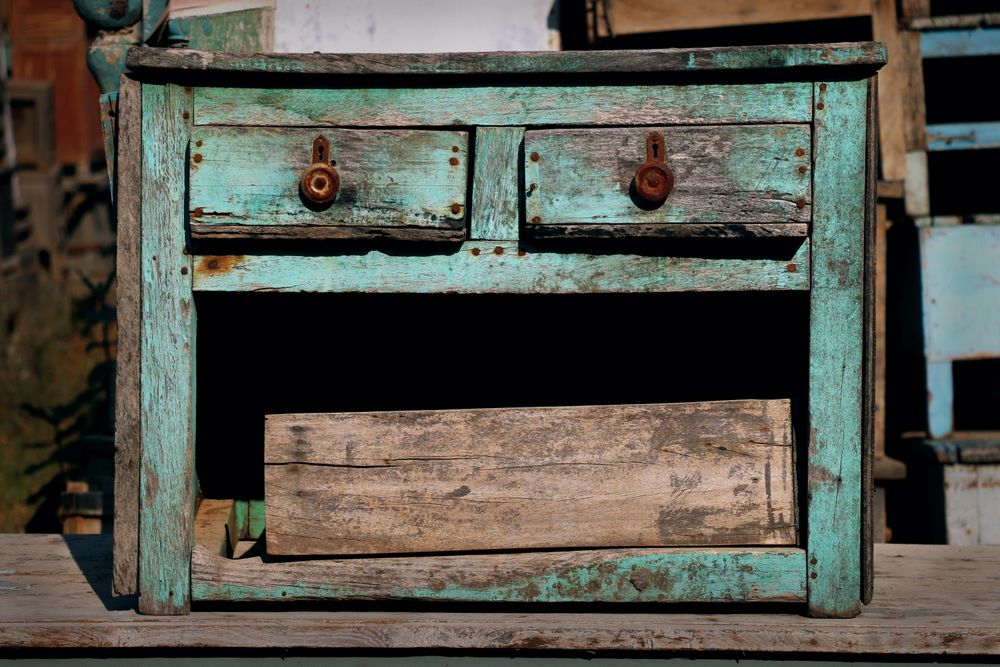
Nails, screws and shellac: the hardware and surface timeline
Fasteners date repairs as readily as originals. Thomas Visser of the University of Vermont gives the nail sequence: hand-wrought before about 1800, early Type A cut nails from the 1790s to 1820s, Type B from the 1810s to 1900s, and wire nails from about the 1890s. The burr tells them apart: on Type A the burrs sit on diagonally opposite edges, on Type B both sit on the same side. Steel-wire nails were 10 percent of U.S. output by 1886, passed iron cut nails within six years, and reached 90 percent by 1913. A wire nail in a supposed 1840 chest means a later repair, a replaced back or a reproduction.
Screws are just as telling. A 2004–05 survey of Museum of Fine Arts, Boston furniture by conservator Christopher White found hand-made screws covered in file marks running in many directions, drawn-wire screws with lengthwise scratches, machine-finished heads with circular marks (earliest example about 1845), and gimlet points that look modern by about 1845.
Finish chemistry adds a second clock. Friction-applied shellac (French polish) became the standard finish on 19th-century mahogany, and factories moved to sprayed nitrocellulose lacquer around 1930. Under long-wave UV, shellac glows a distinctive bright orange; old wood develops a mottled fluorescent patina, while repairs and artificial patination generally do not, according to the National Park Service's Conserve O Gram 1/10. A lack of glow does not prove there is no coating. Shellac also ages in a measurable way. Coelho and colleagues (Polymer Degradation and Stability, 2012) found it cross-links: melt viscosity climbed from 3,100 to 27,350 Pa·s after 15 hours under a lab lamp and the film turned gel-like by 20 hours, with aleuritic acid freed from the polyester backbone. That is a lab acceleration, not a clock for your sideboard, but it fits what restorers see: century-old shellac is brittle and slow to dissolve, while a suspiciously fresh, glossy coat over "ancient" wear is a question.
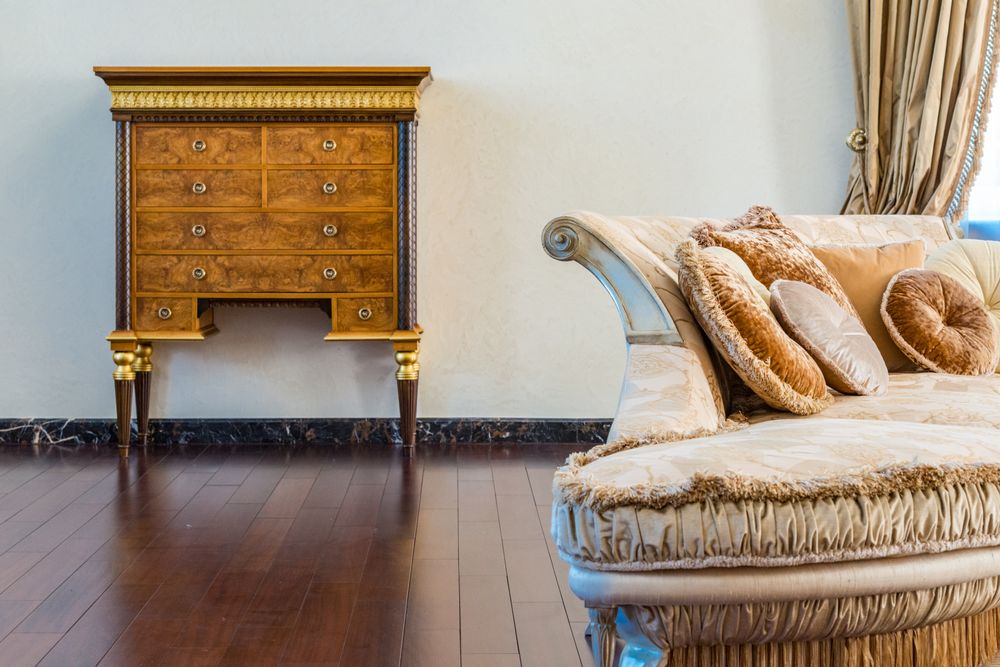
Identifying the wood by image and spectrum, and what Broward humidity does to it
Species identification is moving from the hand lens toward algorithms. Zielinski and colleagues (arXiv:2404.08585, 2024) trained convolutional networks on a dataset of 805 microscope images per cut face (transverse, tangential, radial) across 77 Congolese commercial timbers. A single face scored roughly 78 to 88 percent; fusing all three faces on full-size images reached about 93 percent. The limit is plain: that is a lab method on prepared thin sections, not a phone photo of your table. Mass spectrometry is the other route. In a DART-TOFMS study of 14 American Dalbergia species (318 specimens; IAWA Journal 36(3), 2015, doi 10.1163/22941932-20150102), the spectra separated Brazilian rosewood (D. nigra) from D. spruceana but could not split D. retusa from D. granadillo, which the authors suspect are synonyms. This matters commercially: every Dalbergia species has been in CITES Appendix II since 2 January 2017, and D. nigra has been in Appendix I since 1992. A "rosewood" label is a claim to document, not a fact.
The Pompano factor is moisture. Purdue Extension (FNR-403-W) notes furniture lumber is kiln-dried to 6 to 8 percent. Its table gives an equilibrium moisture content of about 7.7 to 9.2 percent at 70°F and 40 to 50 percent relative humidity, but 15.7 percent at 80°F and 80 percent, and 4.5 percent for a heated northern house at 20 percent. Purdue adds that a shift can take weeks to a month or more. Veneer and the solid wood beneath it move at different rates, so the glue line takes the strain. A chest that spent decades in a dry Midwest home and then moved to a Broward condo roughly triples its moisture content, which is why we see lifted veneer corners, swollen drawers and opened joints. The same piece in an air-conditioned room holds steady; on a lanai or in a storage unit it does not.
Not sure if your piece fits? Text a photo to (561) 465-3536 — we will tell you honestly and for free, with no obligation to sell.
Questions
Selling antique & estate furniture in Pompano Beach
Do you buy furniture damaged by Pompano Beach humidity?
Often, yes. Lifted veneer, stuck drawers and opened joints reduce value but rarely end it, because maker, construction and originality drive the price. Send photos of the damage and the drawer corners. We judge the piece on its construction first, and we tell you honestly if the humidity damage has gone past repair.
How can I tell if my dovetails are hand-cut before you visit?
Photograph a drawer corner in good light. Uneven tail widths and faint saw marks in the sockets suggest hand work; perfectly identical joints suggest a machine; rounded pin-and-cove joints mean 1871 to about 1900. Please do not unscrew or pull hardware to check, since removal can damage a piece.
Should I refinish my Broward estate furniture before selling?
No. Stripping removes the original shellac and the patina that proves age, and it usually lowers value. Dust it and leave the surface alone. We look at the finish under UV and by hand, and a fresh coat can hide the evidence we need.
Can you evaluate rosewood furniture in Pompano Beach?
Yes. Because all Dalbergia species are CITES-listed and Brazilian rosewood is Appendix I, we ask what documents you have, such as old receipts or appraisals. We cannot confirm the species from a photo alone, so tell us what you know of the piece's history.
Will you come to my Pompano Beach or Broward County home?
Yes, we visit homes, condos and estates in Pompano Beach and across Broward County. Start by sending photos of the front, the drawer corners, the back boards and any maker's marks, and we will tell you whether a visit is worth your time.
We also buy